Scenario-based EMS training covering ePCR narrative writing and MCI triage,
with AI-powered scoring, team drills, and guided practice tools.
Built for solo EMTs and entire departments alike.
Every tool your crew needs, from MCI triage practice to consistently
clean ePCR documentation.
250+ Narrative Scenarios
The calls you actually run: chest pain, trauma, respiratory distress, stroke,
overdose, obstetric emergencies, and more. Basic through advanced difficulty.
MCI Triage Training
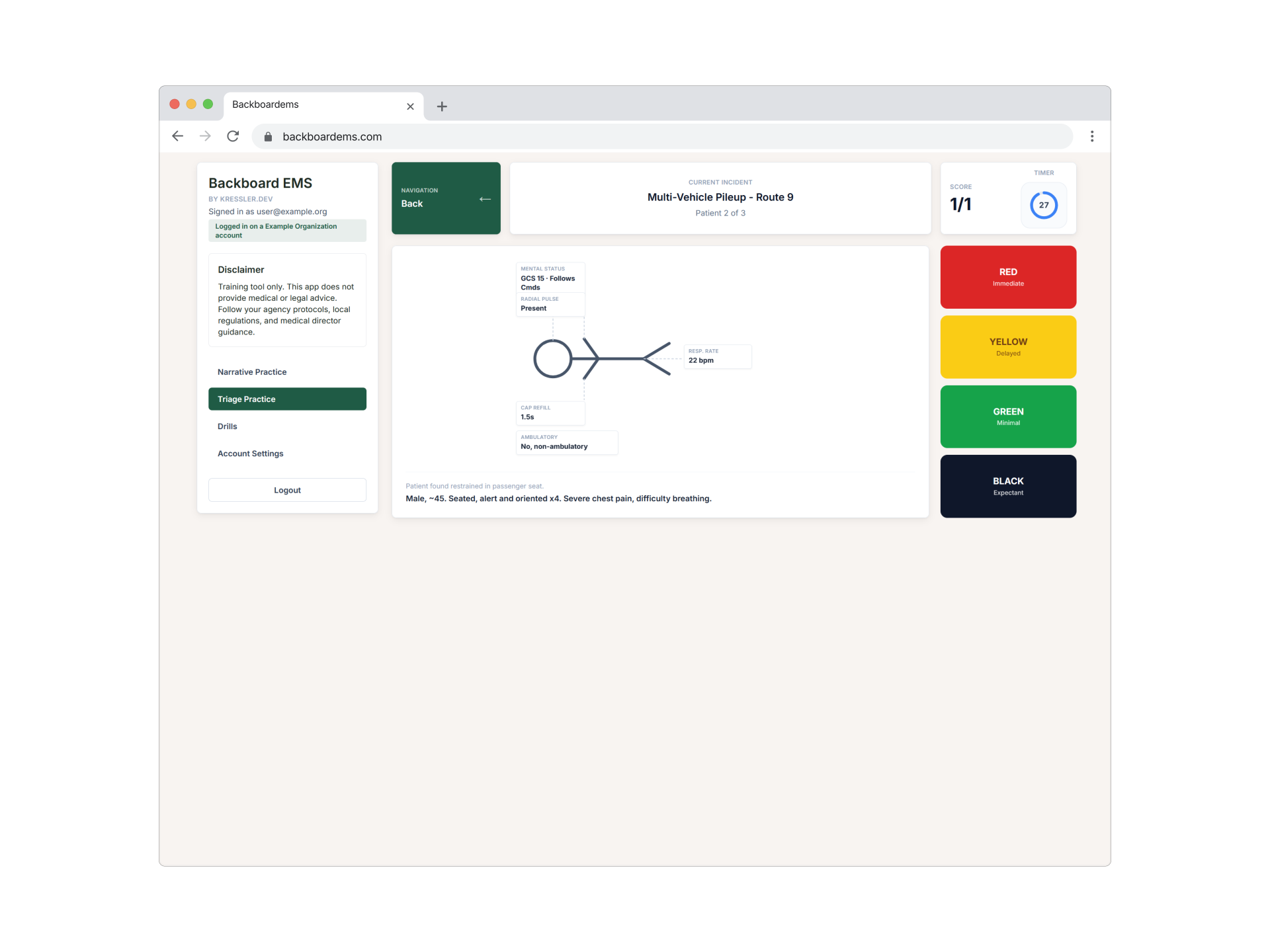
Practice the START algorithm on pre-built mass casualty incidents. Assess
patients in 30 seconds, assign tags, and see your accuracy score with a full
patient breakdown.
Draft My Narrative
A guided, section-by-section narrative builder walks you through dispatch,
HPI, assessment, vitals, interventions, and transport, then assembles it all.
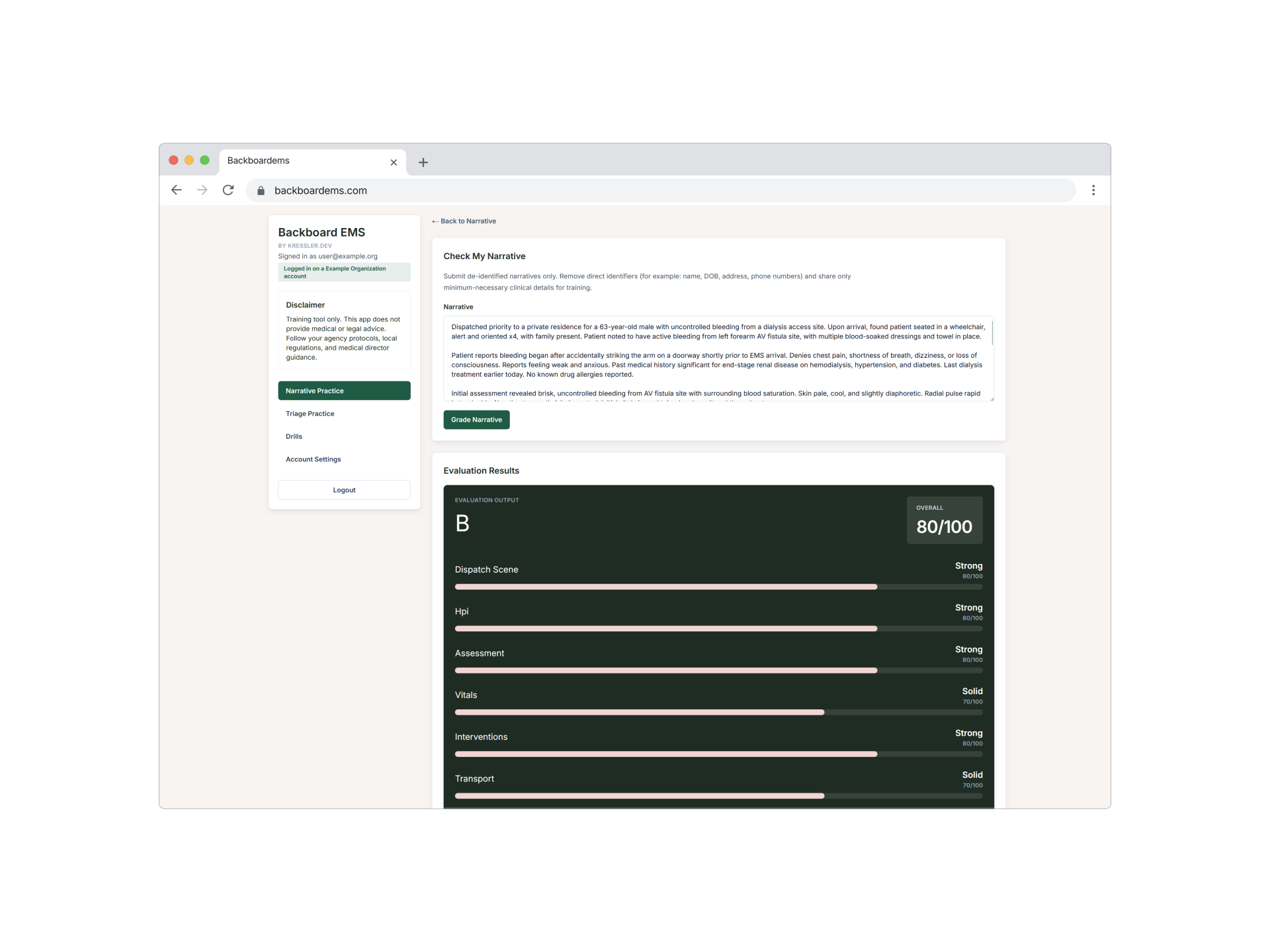
Grade My Narrative
Paste any narrative from a real call, a textbook, or another system
and get instant AI rubric scoring across all 7 documentation categories.
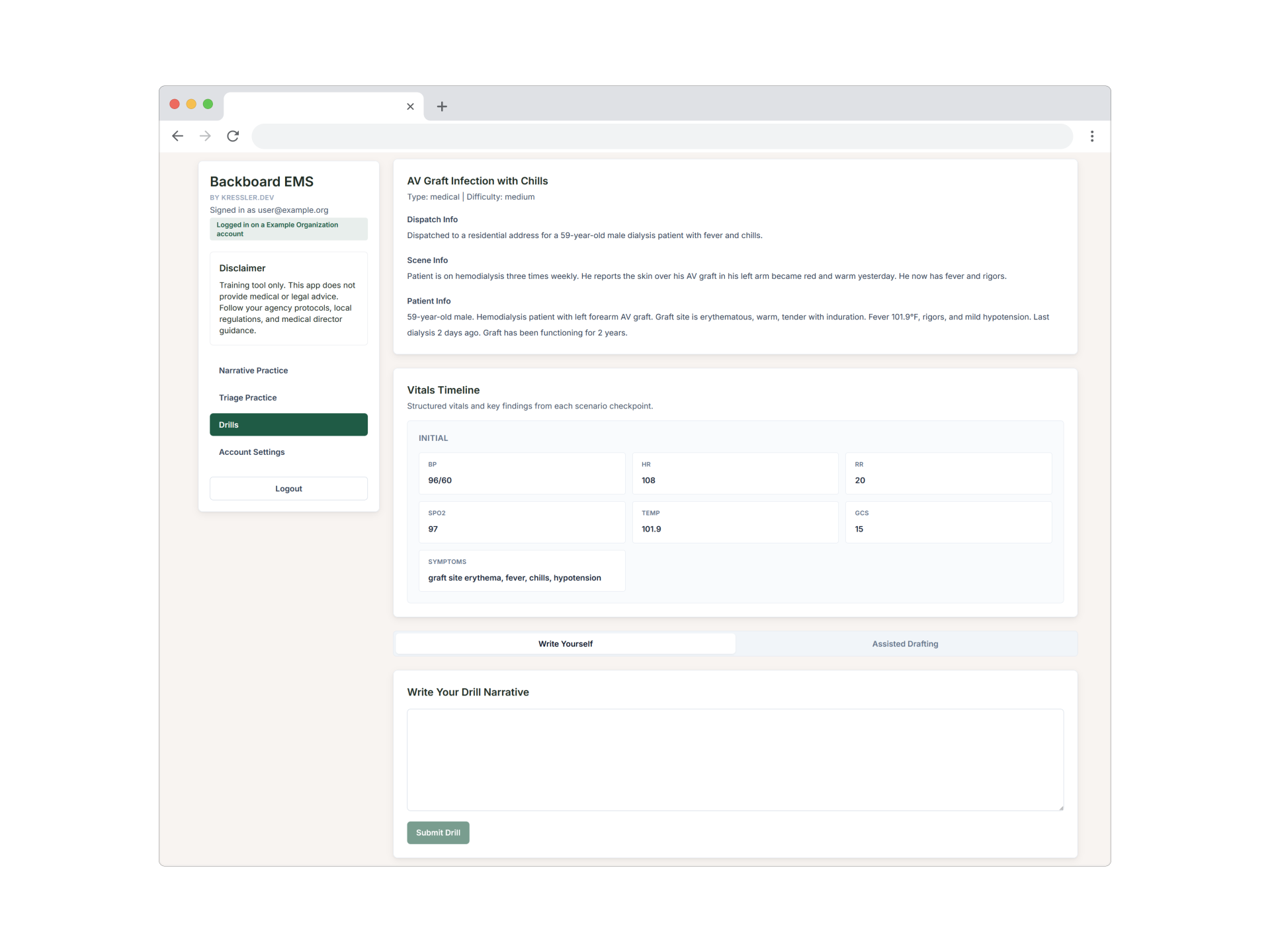
Narrative Drills
Chiefs launch a narrative drill, crews submit anonymously, and you get a full
squad report with scores, common documentation gaps, and training focus areas.
Triage Drills
Chiefs launch an MCI incident as a drill, crew submits triage tags, and the
accuracy report shows which patients were most commonly mis-tagged and where
the team needs work.
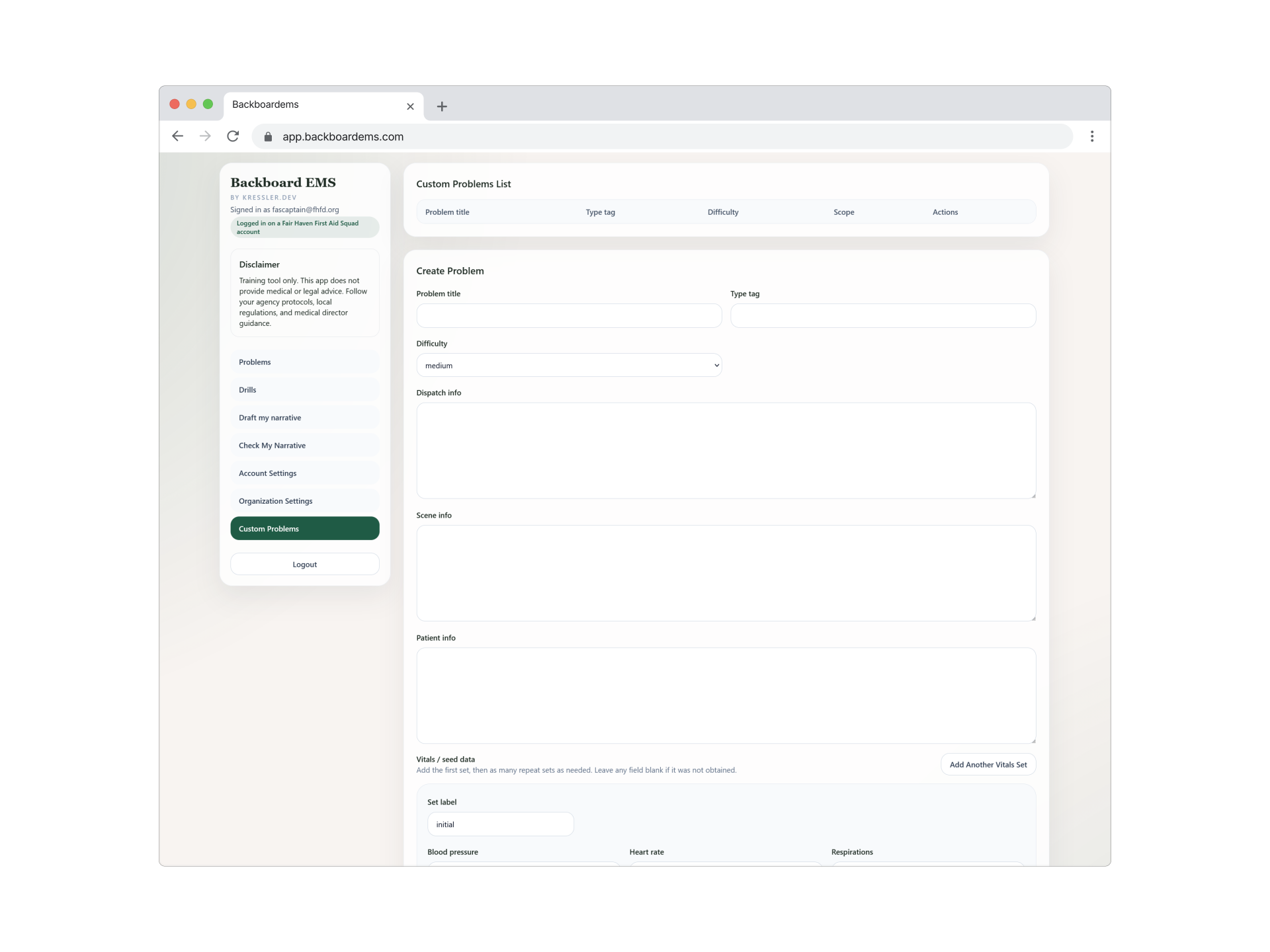
Custom Problems
Agency admins build custom scenarios scoped to their department.
Train on your call types, your protocols, your region's specific challenges.
Google Workspace SSO
Configure your department's Google Workspace domain and your entire crew
signs in with one click. No invitations, no passwords, no IT tickets.
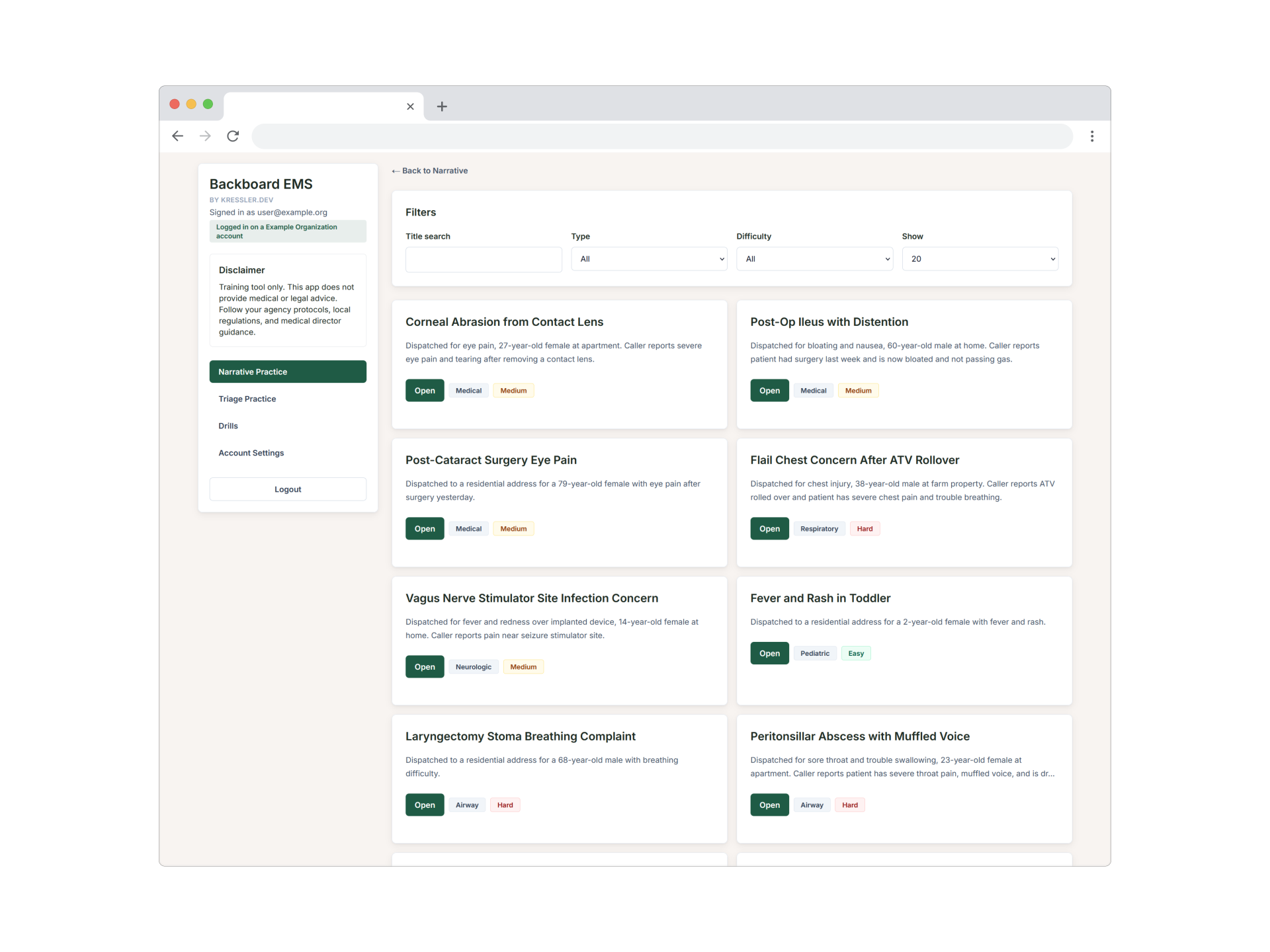
Practice Library
250+ true-to-life scenarios, ready to go.
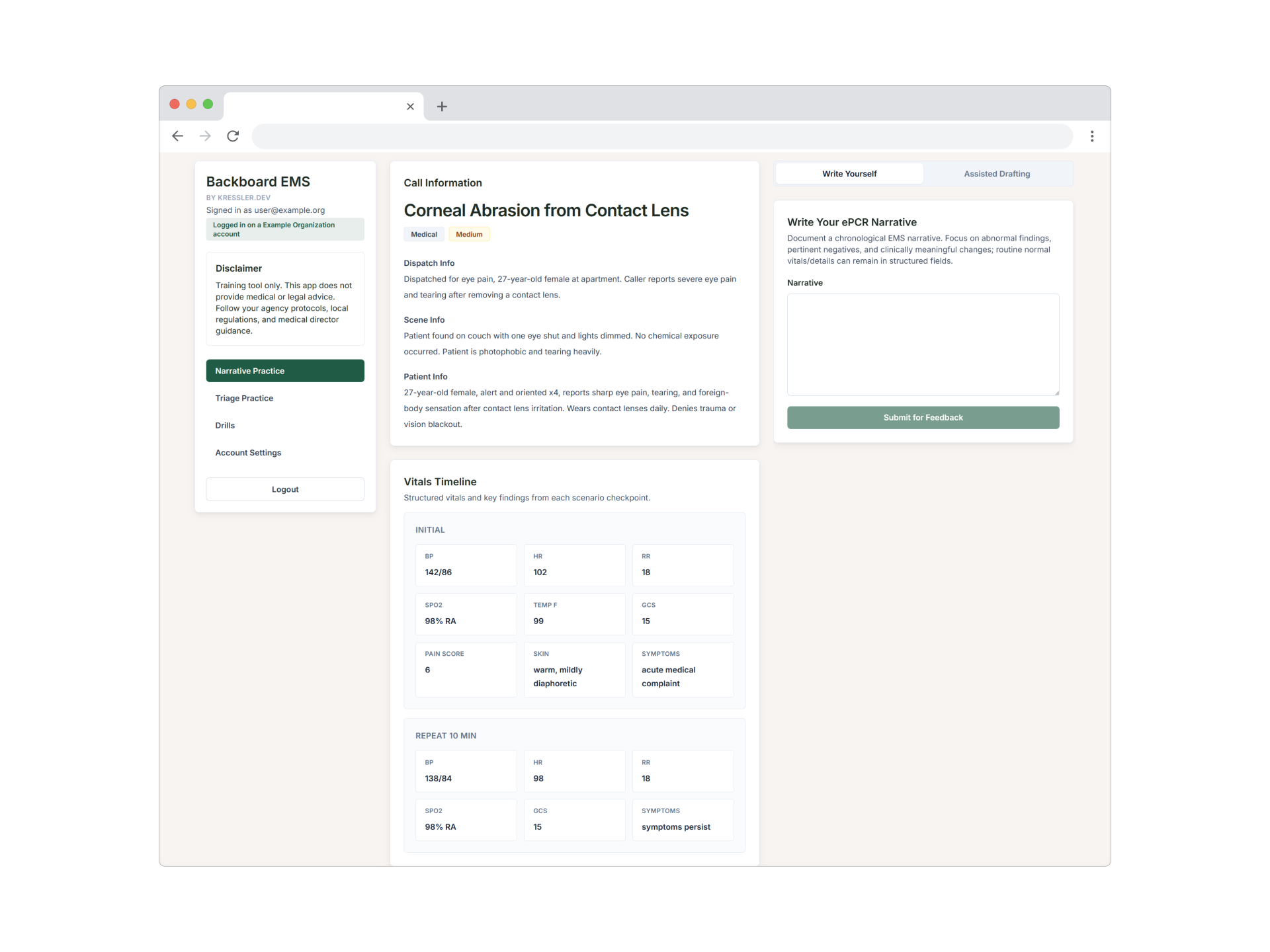
Every narrative scenario comes with realistic dispatch info, scene conditions,
patient presentation, and vitals. Triage incidents put you inside a live mass
casualty event with multiple patients to sort under time pressure. Just like
a real call, or a real MCI.
Medical and trauma narrative calls written from the BLS perspective
Triage incidents: Multi-Vehicle Pileup, Train Derailment, Building Collapse, Concert Shooting, and more
Three narrative difficulty levels: Basic, Intermediate, Advanced
New scenarios and incidents added regularly
MCI Triage Training
Practice the START algorithm under pressure.
Pick an MCI incident, step through each patient, and make triage decisions
in 30 seconds. When time's up, see your full accuracy report: which patients
you tagged correctly, which you missed, and why it matters.
Pre-built incidents: Multi-Vehicle Pileup, Train Derailment, Building Collapse, Concert Shooting, and more
30-second timer per patient mirrors real decision pressure
Assign GREEN / YELLOW / RED / BLACK using the START algorithm
Instant accuracy score with patient-by-patient breakdown
AI Rubric Scoring
Instant, consistent feedback on every submission.
Submit your narrative and the AI evaluates it against a rigorous
7-category rubric in seconds. The same standard every time, with no rater bias.
Letter grade + per-category scores
Specific missing elements called out
Strengths identified alongside gaps
Suggested rewrites for weak sections
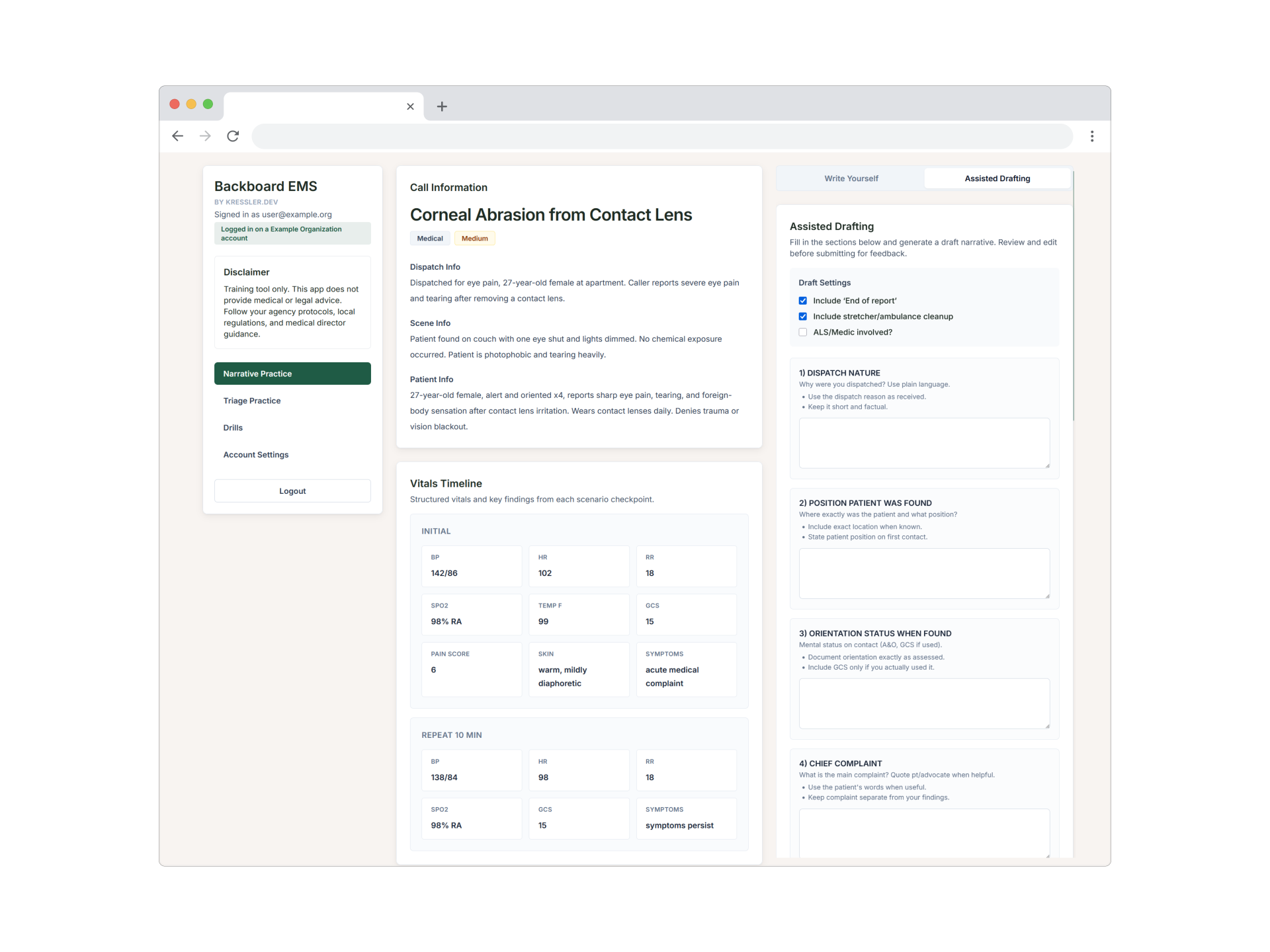
Assisted Drafting
Write directly in the scenario, with guidance alongside.
Assisted drafting puts structured prompts right next to the scenario so you
never lose your place. Work through each section of the narrative without
switching screens.
Dispatch, HPI, assessment, vitals, interventions, and transport prompts
Stays in context with the scenario you're working on
Helps build narrative structure without breaking your flow
Great for learners who need a little more scaffolding
Agency Feature
Run triage drills before a real MCI reveals your gaps.
Chiefs launch a triage drill using any MCI incident. Crew members work through
it independently, submit their tags, and the accuracy report shows which patients
were most commonly mis-tagged, where the team's triage logic breaks down, and
what to train next.
Crew submits independently; see the spread of accuracy across your team
Patient-by-patient report: correct tags, common errors, percentage breakdown
AI analysis of where your team's START application needs work
Chiefs can run unlimited triage drills
Agency Feature
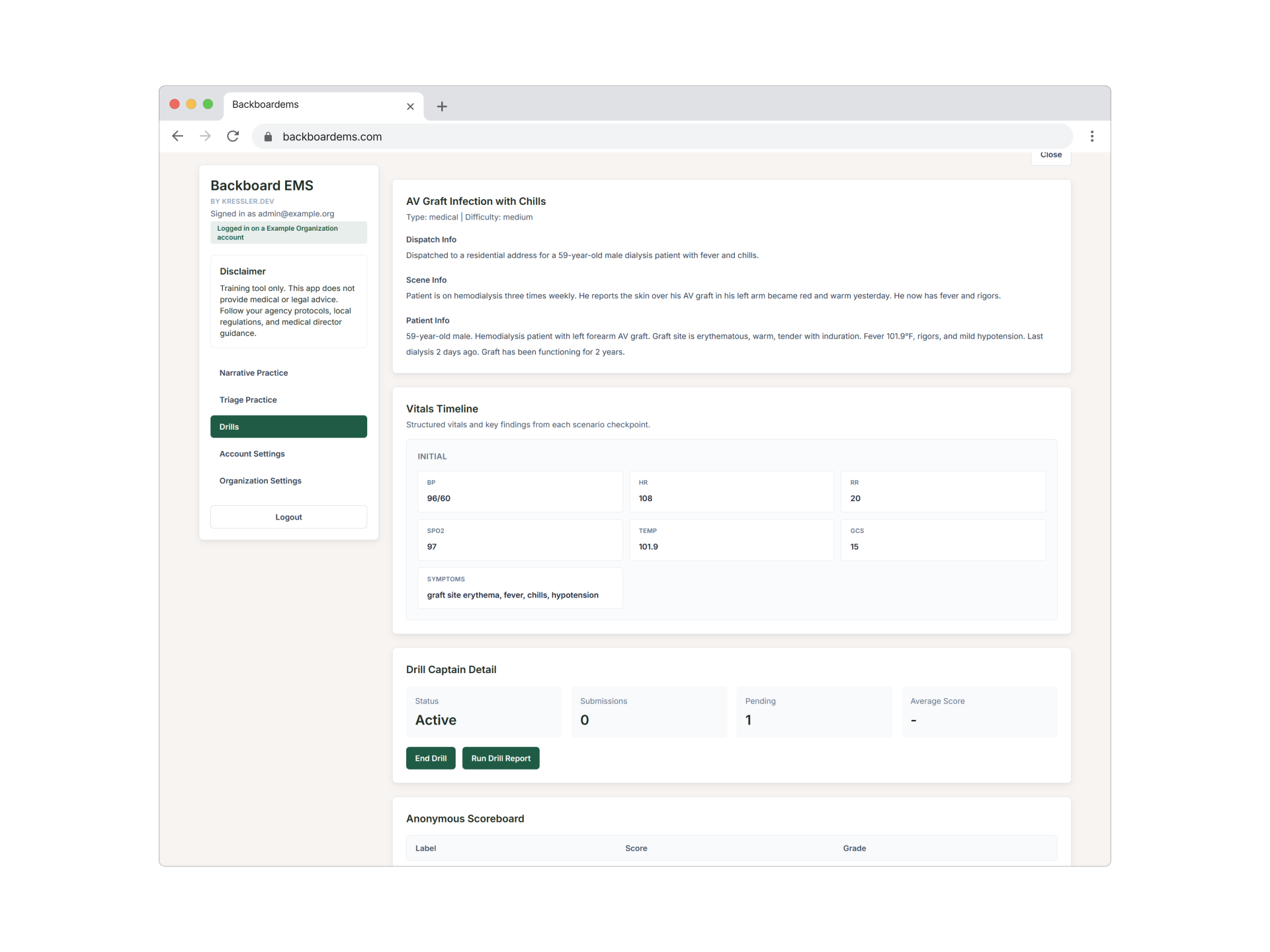
Run narrative crew drills and find your documentation gaps.
Launch a narrative drill, let your crew submit anonymously, then pull up the
full squad report. Know exactly where your department needs work, before
QA flags it.
Anonymous submissions protect crew confidence
Squad scorecard with anonymous leaderboard
AI-generated report: common mistakes & training focus areas
Chiefs and captains can run unlimited narrative drills
Agency Feature
Train on your calls, your protocols.
Every department is different. Custom Problems lets agency admins build
their own scenarios, scoped exclusively to their organization, so your
crew trains on the calls they actually run.
Create unlimited custom scenarios
Scenarios appear alongside the 250+ built-in library
Scoped to your organization, private to your crew
Use in drills or individual practice
Pricing
Simple pricing for solo practice and agency rollouts.
Start with a free demo. Scale to your full department whenever you're ready.
Solo
$2.50/mo
$30 billed annually
1 learner seat
250+ scenarios, unlimited access
MCI triage practice
Draft My Narrative
Grade My Narrative
Narrative & triage drills
Custom problems
Login with Google
Most Popular
Small Agency
$40/mo
$480 billed annually
Up to 25 user seats
250+ scenarios, unlimited access
MCI triage practice
Draft My Narrative
Grade My Narrative
Narrative & triage drills
Custom problems
Org dashboard & user management
Google Workspace SSO support
Agency
$100/mo
$1,200 billed annually
Up to 100 user seats
250+ scenarios, unlimited access
MCI triage practice
Draft My Narrative
Grade My Narrative
Narrative & triage drills
Custom problems
Org dashboard & user management
Google Workspace SSO support
Enterprise
Custom
tailored pricing
Unlimited user seats
250+ scenarios, unlimited access
MCI triage practice
Draft My Narrative
Grade My Narrative
Narrative & triage drills
Custom problems
Org dashboard & user management
Google Workspace SSO support
Start by signing up as a free demo account, try it out, and if you like it, upgrade to one of our paid plans. No credit card required to start.
Your narrative is evaluated by a large language model against a rigorous
7-category rubric: dispatch & scene size-up, history of present illness,
patient assessment, vital signs, interventions, transport, and documentation quality.
The AI returns a letter grade, per-category scores, missing elements, identified strengths,
and suggested rewrites for weak sections. It's calibrated against state EMT BLS scope
of practice (currently NJ BLS).
Yes. You can create a free demo account instantly, no credit card required.
The demo gives you access to 5 narrative scenarios with full AI rubric scoring
and 2 MCI triage incidents, so you can see the quality of both training
tools before committing to a plan.
The library includes 250+ scenarios covering the calls BLS providers respond to:
chest pain, cardiac arrest, respiratory distress, stroke, trauma, overdose/toxicology,
diabetic emergencies, obstetric emergencies, pediatric calls, behavioral health,
and more. Every scenario is written from the BLS documentation perspective.
Scenarios span Basic, Intermediate, and Advanced difficulty levels.
Agency plans can also add custom scenarios on top of the built-in library.
There are two drill types. For narrative drills, a captain selects a scenario and launches a drill. Crew members submit their narratives anonymously, and the drill report shows overall squad performance, common documentation mistakes, and AI-identified training focus areas.
For triage drills, a chief launches an MCI incident and crew members work through it independently. The accuracy report shows which patients were most commonly mis-tagged across the team, the spread of accuracy, and where START application needs work. Both drill types are available on agency plans.
Pick an MCI incident: Multi-Vehicle Pileup, Train Derailment, Building Collapse, Concert Shooting, and more. You step through each patient and have 30 seconds to assign a triage tag: GREEN (minor), YELLOW (delayed), RED (immediate), or BLACK (expectant/deceased) using the START algorithm. After all patients are tagged, you get an accuracy score with a patient-by-patient breakdown of correct vs. missed decisions. Free demo accounts get access to 2 incidents; paid plans get all incidents. Agencies can also run triage incidents as team drills.
Agency admins configure their department's Google Workspace domain in the
org dashboard. Once configured, any user with a matching email domain clicks
"Sign in with Google" and is automatically placed into your organization.
no invitations, no manual user creation, no IT tickets. If you don't use
Google Workspace, you can still create user accounts manually from the admin panel, or give your agency members a join code.
Backboard EMS is a standalone training tool. It is not an integration layer
for your production ePCR, CAD, or EHR systems. You write training narratives
directly in the app against simulated scenarios. This keeps the training environment
completely separate from live patient data.
The AI rubric is currently calibrated against NJ BLS EMS scope of practice
and documentation standards. Additional state protocols are on the roadmap.
If your state or system has specific requirements you'd like supported,
reach out at [email protected].
Ready to train your crew?
We'll help you configure your org, set up Google Workspace SSO,
and get your first narrative and triage drills running on day one.